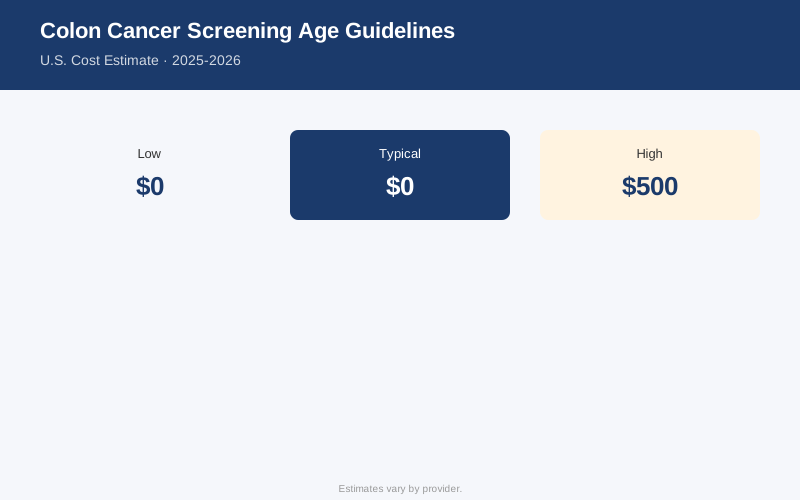
When to Start Colon Cancer Screening: Age Guidelines and Costs
In 2021, the American Cancer Society lowered the recommended starting age for colorectal cancer screening from 50 to 45. The U.S. Preventive Services Task Force (USPSTF) followed suit in May 2021, officially lowering its recommendation to age 45 as well. Millions of Americans now qualify for screening — and free preventive coverage under the ACA — five years earlier than they did before.
If you turned 45 and haven’t been screened, here’s what you need to know about your options and what each one costs.
Current Screening Guidelines by Age Group
| Age Group | Recommendation | Notes |
|---|---|---|
| 45–75 (average risk) | Begin screening | ACS and USPSTF both recommend starting at 45 |
| 76–85 (average risk) | Individual decision | USPSTF: discuss with doctor; benefits may be lower |
| 86+ (average risk) | Not recommended | Limited life-expectancy benefit; ACS concurs |
| Under 45, high risk | Earlier screening | Family history, Lynch syndrome, IBD — see below |
| Any age with symptoms | Diagnostic colonoscopy | Rectal bleeding, unexplained weight loss: skip screening tests |
What Counts as “High Risk”?
Roughly 15–20% of colorectal cancers occur in people with a family history, according to the American Cancer Society. High-risk individuals should start screening earlier and more frequently:
- First-degree relative with colorectal cancer or advanced polyp: Start screening at age 40, or 10 years before the relative’s diagnosis (whichever comes first)
- Lynch syndrome or hereditary CRC syndromes: Colonoscopy starting at 20–25, every 1–2 years
- Familial adenomatous polyposis (FAP): Annual flexible sigmoidoscopy starting at puberty
- Personal history of inflammatory bowel disease (Crohn’s or ulcerative colitis): Surveillance colonoscopy 8 years after IBD onset, then every 1–3 years
If you’re in any of these categories, talk to your GI doctor — your screening schedule is more aggressive and your insurance coverage pathway is different (diagnostic vs. preventive).
Your Screening Options and Their Costs
There are multiple approved screening methods. Colonoscopy is the most comprehensive but not the only valid option.
| Screening Method | Frequency | Cash Price | ACA Coverage |
|---|---|---|---|
| Colonoscopy | Every 10 years (normal result) | $800 – $4,500 | Free (preventive) |
| Cologuard (stool DNA test) | Every 3 years | $500 – $650 | Free (preventive) |
| FIT (fecal immunochemical test) | Annually | $20 – $60 | Free (preventive) |
| FOBT (guaiac fecal occult blood test) | Annually | $5 – $25 | Free (preventive) |
| CT colonography (virtual colonoscopy) | Every 5 years | $500 – $1,500 | Varies by insurer |
| Flexible sigmoidoscopy | Every 5–10 years | $200 – $900 | Free (preventive) |
The ACA “Free Preventive” Rule: What It Actually Means
Under the Affordable Care Act, USPSTF Grade A and B recommendations are covered at no cost-sharing on most private insurance plans and marketplace plans. The USPSTF’s grade A recommendation for CRC screening at ages 45–75 means:
- No copay
- No deductible
- No coinsurance
This applies to colonoscopy, Cologuard, FIT tests, and FOBT. The catch: the procedure must be billed as preventive — not diagnostic. If your colonoscopy starts preventive and a polyp is found and removed, some insurers recode it as diagnostic and charge you. This “polyp penalty” is increasingly being addressed by state laws, but it remains an issue with some plans.
The Polyp Penalty: Know Before You Go
If your colonoscopy finds and removes a polyp, your insurer may recode the claim from preventive to diagnostic — meaning you suddenly owe a deductible or coinsurance.
States with laws protecting against this practice (as of 2025) include California, New York, Illinois, and others. Federal law since 2022 requires that plans no longer impose cost-sharing when a polyp is removed during a scheduled preventive colonoscopy — but implementation varies by plan grandfathering status.
Before your colonoscopy, call your insurer and ask: “If a polyp is removed, will this remain billed as preventive with no cost-sharing?” Get the answer in writing if possible.
Comparing Screening Tests: What’s Right for You?
Colonoscopy: The gold standard. Detects and removes polyps in a single procedure. One test covers you for 10 years if results are normal. Requires bowel prep and sedation; takes a day. About 1 in 500–1,000 colonoscopies has a serious complication.
Cologuard: A stool DNA test mailed to your home. No bowel prep, no doctor’s office. Detects 92% of colon cancers and 42% of advanced precancerous polyps per its FDA trial data. Positive results require follow-up colonoscopy. More false positives than colonoscopy.
FIT test: A simple stool test that detects blood. $20–$60, done at home, no prep. Very high adherence rate because it’s easy. Must be done annually. Positive result requires colonoscopy. About 60–80% sensitive for colorectal cancer depending on the brand and protocol.
CT colonography: Excellent visualization, no sedation required. But if a polyp is found, you still need a colonoscopy to remove it — two procedures instead of one. Not uniformly covered as preventive by all insurers.
The “best” test is the one you’ll actually complete. Colorectal cancer is nearly 90% survivable when caught at an early, localized stage, per the ACS’s 2024 Cancer Facts and Figures. The survival rate drops to 17% for distant-stage disease. Any screening is dramatically better than none.
Medicare Coverage by Age
Medicare has separate rules:
- Age 45–49: Not covered by Medicare (you’re not yet Medicare-eligible unless disabled)
- Age 50+, colonoscopy (average risk): Covered every 10 years, no cost-sharing
- Age 50+, FIT/FOBT: Covered annually, no cost-sharing
- Age 50+, Cologuard: Covered every 3 years for average-risk adults 50–85
- High-risk patients: Colonoscopy covered every 2 years, no cost-sharing
What to Do If You’re 45 and Uninsured
Your options for low-cost or free screening:
- Federally Qualified Health Centers (FQHCs): Offer sliding-scale fees for colonoscopy prep, FIT kits, and referrals
- CDC’s Colorectal Cancer Control Program (CRC-CCP): Funds free or low-cost screening in select states for uninsured/underinsured adults 45–75
- Direct-to-consumer FIT kits: Available for $25–$40 online (ARUP, ExactSciences, others) — requires a physician order in most states but some telehealth services facilitate this inexpensively
- Free colonoscopy programs: Many major academic medical centers offer free colonoscopy programs for uninsured low-income patients; see our guide to free and low-cost colonoscopies for details
There’s no wrong way to start screening at 45 — the first step is simply to do it.