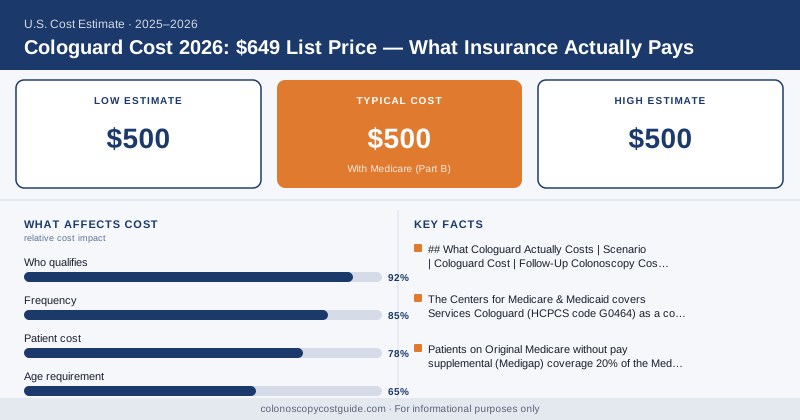
Cologuard Cost 2026: $649 List Price — What Insurance Actually Pays
{ if eq .Lang "zh" }{ else }{ end }Here’s something Cologuard’s commercials don’t mention: about 1 in 7 people who take it and don’t have cancer will get a positive result. That means a follow-up colonoscopy — which costs $1,500–$3,500 without insurance and may not be covered as preventive care even with insurance.
That doesn’t make Cologuard a bad test. It makes it a test you should understand financially before you order it.
What Cologuard Actually Costs
| Scenario | Cologuard Cost | Follow-Up Colonoscopy Cost |
|---|---|---|
| With Medicare (Part B) | $0 | $0–$500 (varies by supplement) |
| With commercial insurance (in-network) | $0–$30 copay | $200–$1,500 (diagnostic, not preventive) |
| Without insurance (self-pay) | $649 | $1,500–$3,500 |
| Exact Sciences Patient Assist Program | Reduced or $0 | Not covered by program |
The $649 is the standard list price for the test, which you collect at home and mail to Exact Sciences’ lab in Madison, Wisconsin. There’s no doctor visit required for the test itself — just a prescription from your physician.
Medicare Coverage: The Gold Standard for Cologuard
Medicare is where Cologuard’s coverage is clearest. The Centers for Medicare & Medicaid Services covers Cologuard (HCPCS code G0464) as a colorectal cancer screening test:
- Who qualifies: Average-risk beneficiaries aged 45–75 with no symptoms, no personal history of colorectal cancer or adenomas, no inflammatory bowel disease, no family history meeting high-risk criteria
- Frequency: Once every 3 years
- Patient cost: $0 — no deductible, no coinsurance under Medicare Part B preventive benefits
The 3-year interval matters. If you’re tested every 3 years from age 45 to 75, that’s about 10 tests — completely covered. By comparison, the screening colonoscopy interval for average-risk patients is every 10 years.
The Medicare False Positive Trap
Commercial Insurance Coverage
Most major commercial plans (BCBS, Aetna, UnitedHealthcare, Cigna, Humana) cover Cologuard as a preventive benefit with no patient cost-sharing — like mammograms or blood pressure screening. Coverage has expanded since the USPSTF updated its colorectal cancer screening recommendations in 2021 to include Cologuard for average-risk adults 45–75.
What varies between plans:
- Age requirement: Most start at 45, some at 50
- Interval: Most cover every 3 years, matching the FDA labeling and USPSTF recommendation
- Risk classification: “Average risk” must be documented. If you have a family history of colorectal cancer, you’re typically classified as high risk and Cologuard may not be the recommended test — colonoscopy usually is
- Positive result follow-up: This is where it gets complicated. If Cologuard is positive, the colonoscopy is diagnostic. Many commercial plans waive cost-sharing for the follow-up colonoscopy, but not all. Always call your insurer before the colonoscopy to confirm how it’s classified.
Cologuard vs. Colonoscopy: The Real Cost Comparison
The commercials make Cologuard sound like the frugal choice. The math is more complicated.
| Factor | Cologuard (Every 3 Years) | Colonoscopy (Every 10 Years) |
|---|---|---|
| Test/procedure cost (insured) | $0 | $0 (preventive) |
| Total tests age 45–75 | ~10 tests | ~3 procedures |
| False positive rate requiring colonoscopy | ~13% per test | N/A |
| Lifetime false positive probability (10 tests) | ~75% chance of at least one | N/A |
| Polyp removal during same session | No — requires separate colonoscopy | Yes — immediate |
Here’s the key point: Cologuard detects cancer and large polyps, but it can’t remove them. A positive result always means a colonoscopy. A colonoscopy finds polyps and removes them in one session — no second procedure, no false positives.
The CDC estimates that colorectal cancer is the second-leading cause of cancer death in the US, with approximately 153,000 new cases diagnosed annually. The screening test you’ll actually use consistently is better than the perfect test you avoid.
Who Cologuard Is Right For
Cologuard is a good fit if:
- You’re at average risk and 45–75 years old
- You’re covered by Medicare or insurance that fully covers it
- You have significant anxiety about colonoscopy sedation or prep
- You have medical conditions that make colonoscopy higher risk (blood thinners you can’t stop, significant comorbidities)
- You’ve been putting off colonoscopy — Cologuard you’ll actually do beats a colonoscopy you keep delaying
Cologuard is a poor fit if:
- You have a family history of colorectal cancer (guidelines recommend colonoscopy starting at 40 or 10 years before the youngest affected family member)
- You’ve had polyps before — you’re now high risk and need colonoscopy surveillance
- You have symptoms (rectal bleeding, changes in bowel habits, unexplained weight loss) — that’s diagnostic territory, not screening
If You’re Uninsured: Exact Sciences Assistance
Exact Sciences offers a patient assistance program for uninsured or underinsured patients. Income-based eligibility can reduce cost to $0 or a nominal fee. Visit the Exact Sciences website or call their patient support line to apply — they process applications quickly and your doctor’s office can help with the paperwork.
The $649 list price is the worst-case number. Most people pay far less — or nothing.
{ if eq .Lang "zh" }