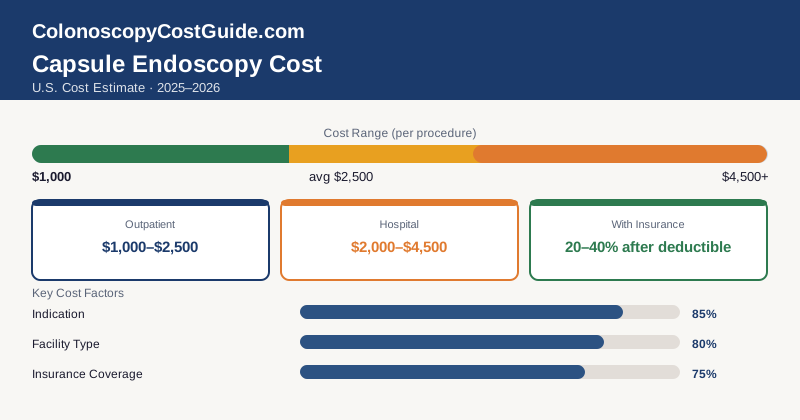
Capsule Endoscopy Cost: What You'll Pay for the Swallowable Camera
{ if eq .Lang "zh" }{ else }{ end }What does it cost to swallow a tiny camera and have it film your digestive tract? More than you’d expect — and insurance is pickier about covering it than most patients realize.
Capsule endoscopy is one of the more remarkable tools in GI medicine. You swallow a vitamin-sized capsule containing a camera, a light source, and a wireless transmitter. Over the next 8 to 12 hours, it takes thousands of images of your digestive tract as it moves through. A receiver worn on a belt records everything. Your doctor downloads the images and reviews them. No sedation. No scopes. No recovery time.
The catch: it’s expensive, the colon version is different from the small-bowel version, and insurers have strict criteria for when they’ll pay.
How Much Does Capsule Endoscopy Cost?
| Capsule Type | Facility Fee | Physician Fee | Total Typical Range |
|---|---|---|---|
| Small bowel capsule endoscopy | $1,000 – $2,500 | $400 – $900 | $1,500 – $3,400 |
| Colon capsule endoscopy | $1,200 – $3,000 | $400 – $900 | $1,600 – $3,900 |
| Image reading/interpretation fee | Included or $200–$400 | Often bundled | — |
| Prep medications (colon capsule) | $30 – $150 | — | Add to total |
These figures reflect charges at outpatient GI centers. Hospital-based programs charge significantly more — you’ll see facility fees as high as $4,500 at academic medical centers. If you’re paying out of pocket, a freestanding GI center is almost always the better choice.
Small Bowel vs. Colon Capsule: Different Tools, Different Costs
This distinction matters both clinically and financially.
Small bowel capsule endoscopy (CPT 91110) examines the small intestine — the 20+ feet of intestine that standard upper endoscopy and colonoscopy can’t reach. It’s most commonly used to investigate obscure GI bleeding, Crohn’s disease activity in the small intestine, or suspected celiac disease when other tests are inconclusive.
Colon capsule endoscopy (CPT 91111) is designed to image the colon. It’s larger than the small bowel capsule and takes more images per second to capture the wider colon. It requires full bowel prep — similar to colonoscopy prep. The colon capsule was intended as an alternative for patients who can’t undergo standard colonoscopy, but it’s far less commonly performed in the US than in Europe.
Why Colon Capsule Isn't Widely Used in the US
Insurance Coverage: When Will Your Plan Pay?
Small bowel capsule endoscopy has the strongest coverage standing. Most major commercial insurers (Aetna, Cigna, UnitedHealthcare, BCBS) cover it as medically necessary when:
- Obscure GI bleeding has not been identified by upper endoscopy and colonoscopy
- Active or suspected Crohn’s disease needs small bowel evaluation
- Surveillance for polyposis syndromes in patients who can’t tolerate standard endoscopy
Coverage generally requires prior authorization. Your GI physician needs to document that standard endoscopy was performed first (or that it’s contraindicated) and didn’t identify the cause of symptoms.
Colon capsule endoscopy coverage is more limited. Most insurers cover it only for patients who had an incomplete colonoscopy due to technical reasons (not patient refusal). Medicare does not currently cover it as a standalone preventive screening benefit.
Medicare Coverage for Capsule Endoscopy
Medicare Part B covers small bowel capsule endoscopy (CPT 91110) when it’s medically necessary — specifically for evaluation of obscure GI bleeding after upper endoscopy and colonoscopy were non-diagnostic. The beneficiary pays the standard Part B cost-sharing: 20% of the Medicare-approved amount after the Part B deductible.
The Medicare-approved amount for small bowel capsule endoscopy runs approximately $800 to $1,200 in most regions of the country, meaning Medicare pays around $640–$960 and the patient owes around $160–$240 (plus the deductible if not yet met).
For colon capsule endoscopy, Medicare coverage is much more limited and typically requires documentation that a conventional colonoscopy was incomplete for anatomical reasons.
| Payer Scenario | Estimated Patient Cost |
|---|---|
| Commercial insurance (medically necessary, in-network) | $200 – $800 after deductible/coinsurance |
| Medicare Part B (small bowel, medically necessary) | $160 – $300 + deductible |
| Self-pay / uninsured (ASC) | $1,500 – $2,800 |
| Self-pay / uninsured (hospital) | $2,500 – $4,000 |
| Denied claim / patient responsibility | $1,500 – $4,000 |
Getting Prior Authorization Right
Capsule endoscopy prior auth denials are common when the documentation doesn’t spell out the clinical rationale clearly. According to the ASGE, capsule endoscopy has the highest diagnostic yield in obscure GI bleeding when performed within 14 days of the bleeding episode. Use that kind of clinical specificity in your authorization request.
If your insurer denies coverage, ask your GI doctor’s office to:
- Document prior endoscopic evaluations and their results
- Specify the clinical indication using language aligned with ASGE guidelines
- Request a peer-to-peer review between your doctor and the insurance medical director
About 30 to 40% of denials are reversed on appeal when the clinical rationale is well-documented. Don’t pay the full bill before appealing.
What to Ask Before Scheduling
Before you agree to capsule endoscopy, get answers to these questions:
- Has my insurer pre-authorized this procedure?
- Is the physician reading the images in-network with my plan?
- Will I receive separate bills from the facility and the physician?
- What’s the cash-pay rate if insurance denies?
- Is a colon or small bowel capsule being used, and why?
The imaging-read fee is often billed separately from the capsule/facility fee. Make sure both are covered by your authorization, not just the capsule placement.
For comparison, a standard colonoscopy cost at an ASC is typically $1,200 to $2,200 — often less expensive than capsule endoscopy, and it lets the physician remove polyps in the same procedure. Capsule endoscopy is the right tool for specific situations, but it’s not a substitute for colonoscopy when colonoscopy is feasible.
{ if eq .Lang "zh" }