Can You Get a Free Colonoscopy? ACA, Medicaid, and Free Programs
Yes — millions of Americans qualify for a free or very low-cost colonoscopy. The path depends on your insurance status, income, and state.
The CDC estimates that colorectal cancer is the second-leading cause of cancer death in the US, yet about 1 in 3 adults between ages 45 and 75 is not up to date on colorectal cancer screening. Cost is one of the biggest barriers. Here’s every legitimate path to a free or near-free colonoscopy.
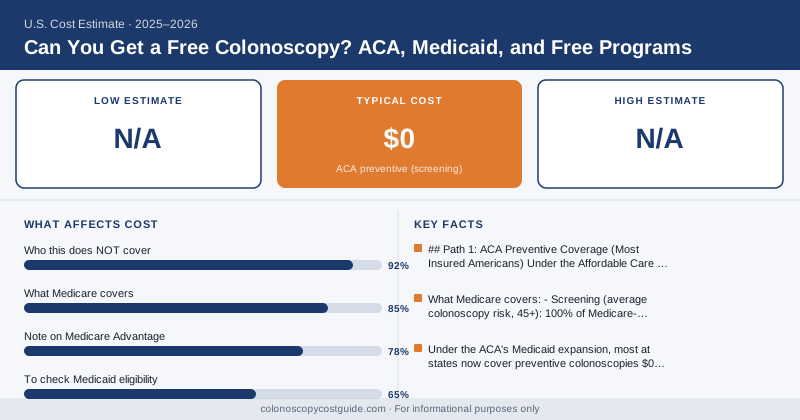
Path 1: ACA Preventive Coverage (Most Insured Americans)
Under the Affordable Care Act, insurance plans that are not “grandfathered” must cover preventive services with an A or B USPSTF rating at $0 cost to the patient — no deductible, no copay, no coinsurance.
Colorectal cancer screening has a USPSTF Grade B recommendation for adults aged 45–75. Colonoscopy is one of the approved screening methods. That means:
- If you’re between 45 and 75
- Have an ACA-compliant insurance plan
- Have no symptoms or prior colorectal cancer history (average-risk screening)
- Schedule a screening colonoscopy (not diagnostic)
Your colonoscopy should cost you $0 out of pocket.
Who this does NOT cover:
- Grandfathered plans (health plans that were in place before March 23, 2010 and haven’t substantially changed)
- Short-term health plans
- Some association health plans
- Patients scheduled for a diagnostic colonoscopy (due to symptoms or positive stool test)
Confirm $0 Coverage Before Scheduling
Call your insurer and say: “I’m scheduling a screening colonoscopy under the ACA preventive coverage benefit. Can you confirm that CPT G0121 or 45378 with Z12.11 diagnosis code will be processed at $0 cost-sharing at [your facility]?”
Also ask: “If a polyp is found and removed, does my plan maintain the preventive status and $0 cost-sharing for the colonoscopy?” Some plans now comply with the 2023 federal guidance that protects preventive status even after polypectomy. Others don’t.
Get the confirmation via email or reference number if possible.
Path 2: Medicare (Age 65+)
Medicare Part B covers screening colonoscopies for average-risk beneficiaries every 10 years, and for high-risk beneficiaries every 2 years. As of January 1, 2023, Medicare eliminated the coinsurance and deductible for screening colonoscopies — even when a polyp is found and removed.
What Medicare covers:
- Screening colonoscopy (average risk, 45+): 100% of Medicare-approved amount, every 120 months
- Screening colonoscopy (high risk): 100% of Medicare-approved amount, every 24 months
- If a polyp is removed: The procedure reclassifies to therapeutic — Medicare now covers it at 100% (per the Consolidated Appropriations Act, 2023)
Note on Medicare Advantage: Medicare Advantage plans must cover the same preventive services as Original Medicare, but network restrictions and prior authorization requirements vary. Call your plan to confirm specific details.
Path 3: Medicaid
Medicaid coverage for colonoscopy varies by state. Under the ACA’s Medicaid expansion, most states now cover preventive colonoscopies at $0 for eligible low-income adults. As of 2024, 41 states and DC have expanded Medicaid.
In expanded Medicaid states, eligible adults typically receive colonoscopy at $0 or nominal cost (under $3 per service under Medicaid cost-sharing rules). In non-expansion states, Medicaid may be limited to pregnant women, children, and very low-income adults.
To check Medicaid eligibility: Visit healthcare.gov/medicaid-chip or your state’s Medicaid website. Income limits vary by state but typically fall around 138% of the federal poverty level ($20,120/year for an individual in 2024 in expansion states).
Path 4: Federally Qualified Health Centers (FQHCs)
FQHCs are community health centers funded by the federal government to provide care regardless of ability to pay. They use a sliding fee scale — your cost is based on your income, not a fixed price.
For uninsured patients:
- Lowest-income patients (below 100% FPL): Often $0 or $5–$20
- Moderate income: $50–$200 depending on the center’s scale
- Higher income: May approach standard rates
FQHCs can perform colonoscopies directly or refer you to a specialist who works with their sliding-fee patients. Find an FQHC at findahealthcenter.hrsa.gov.
| Coverage Path | Who Qualifies | Typical Cost |
|---|---|---|
| ACA preventive (screening) | Insured, ACA-compliant plan, age 45–75, no symptoms | $0 |
| Medicare Part B | Age 65+, or eligible disability | $0 (as of 2023) |
| Medicaid (expanded state) | Low-income, income ≤ 138% FPL | $0 – $3 |
| FQHC sliding scale | Low/no income, uninsured | $0 – $200 |
| NCCCP (see below) | Uninsured, low-income, specific states | $0 |
| Hospital charity care | Low-income, uninsured | $0 – partial |
Path 5: NCCCP and State Screening Programs
The National Colorectal Cancer Control Program (NCCCP), funded by the CDC, provides free or low-cost colorectal cancer screening — including colonoscopies — to low-income, uninsured, and underinsured adults aged 45–75.
The program operates in over 25 states and several tribal organizations. In participating states, eligible patients can receive a free colonoscopy through NCCCP-partner facilities.
To find your state’s program: Visit cdc.gov/cancer/colorectal/ncccp/ or call the CDC info line at 1-800-CDC-INFO (1-800-232-4636).
Eligibility requirements vary by state but generally include:
- Age 45–75
- Uninsured or underinsured
- Income at or below 250% of the federal poverty level
Path 6: Hospital Charity Care and Financial Assistance Programs
Every nonprofit hospital in the US is legally required to have a financial assistance (charity care) program under the ACA. These programs can significantly reduce or eliminate your bill — but you have to apply.
How to access it: After your colonoscopy, call the hospital’s billing department and say: “I’d like to apply for your financial assistance program.” You’ll typically need to provide income documentation (pay stubs, tax return, benefit letters). Applications must usually be submitted within 240 days of the bill date.
Many hospitals will also retroactively forgive bills if you qualify. Don’t assume a bill is final before applying.
What About the Prep — Is That Free Too?
Under ACA preventive coverage, the colonoscopy itself is covered at $0. The prep medication is separately billed as a prescription — your pharmacy benefit applies. With a Tier 1 insurance copay, prep may cost $5–$30. If you’re uninsured, GoodRx brings generic prep cost to $18–$35. The OTC Miralax option runs $25.
For more on free and low-cost colonoscopy pathways, see free low-cost colonoscopy and colonoscopy ACA coverage.