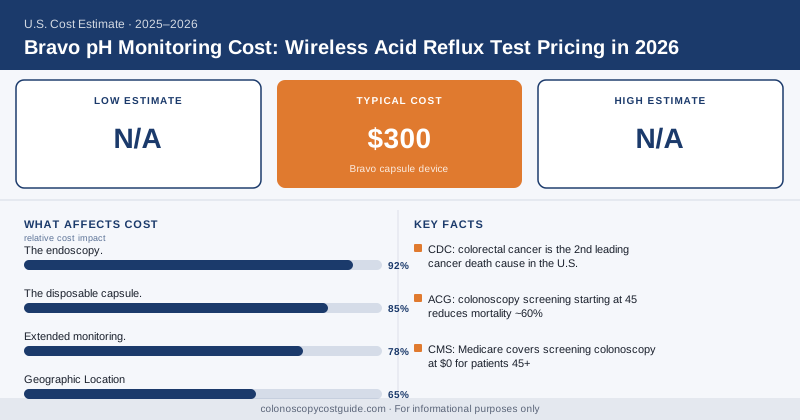
Bravo pH Monitoring Cost: Wireless Acid Reflux Test Pricing in 2026
{ if eq .Lang "zh" }{ else }{ end }Picture wearing a thin tube taped to your nose and threaded down your throat for a full day just to measure stomach acid. Now picture skipping all that with a tiny capsule clipped to your esophagus during a quick scope. That’s the Bravo system — and it runs $1,500 to $4,500 without insurance.
Bravo wireless pH monitoring measures how much acid refluxes into your esophagus over 48 to 96 hours. A capsule the size of a gel pill is attached to the esophageal lining during an endoscopy, then wirelessly beams pH data to a recorder you wear on your belt. Here’s what it costs and why.
What Bravo pH Monitoring Costs
The capsule is a one-time disposable device, but the bulk of the bill is the endoscopy needed to place it.
| Cost Component | Typical Range (Uninsured) |
|---|---|
| Bravo capsule device | $300 – $700 |
| Endoscopy to place capsule | $1,000 – $2,800 |
| Facility fee | $800 – $2,500 |
| Sedation / anesthesia | $400 – $1,200 |
| Data analysis and interpretation | $150 – $500 |
| Total estimate | $1,500 – $4,500 |
Because the capsule is placed during a scope, the cost overlaps heavily with a standard upper endoscopy. The capsule and the extended data recording are the main add-ons.
Why It Costs What It Does
- The endoscopy. Placing the Bravo capsule requires a scope, which brings facility and sedation fees along for the ride. That’s the lion’s share of the total.
- The disposable capsule. It’s single-use medical hardware, billed at $300–$700.
- Extended monitoring. Bravo records 48–96 hours of data versus the catheter test’s 24, and analyzing that larger dataset adds an interpretation fee.
For the broader picture on why anything involving a scope and a sedation team costs this much, why is colonoscopy so expensive walks through the facility math.
Who Needs Bravo Monitoring
This test is for people whose reflux story isn’t clear-cut. Per the American College of Gastroenterology, ambulatory pH monitoring is the gold standard for diagnosing gastroesophageal reflux disease (GERD) when symptoms are atypical, when reflux medications aren’t working, or before anti-reflux surgery to confirm acid is actually the culprit. The National Institute of Diabetes and Digestive and Kidney Diseases (NIDDK) reports that about 20% of the U.S. population experiences GERD symptoms — but only a fraction need objective pH testing to sort out the cause.
Key Takeaway
Insurance Coverage
Bravo is well accepted by payers when there’s a documented reason: chronic heartburn, atypical symptoms like cough or chest pain, poor response to proton-pump inhibitors, or pre-surgical evaluation. Coverage generally mirrors the endoscopy it’s bundled with.
What you’ll actually pay if covered:
- Met deductible: specialist copay ($30–$80) plus any coinsurance on the facility portion.
- Unmet deductible: the contracted rate up to your deductible, which still counts toward it if you have more GI workup coming.
Bravo vs. the Catheter pH Test
The traditional catheter test threads a thin tube through your nose and down into your esophagus for 24 hours. It’s cheaper because there’s no endoscopy and no disposable capsule — but it’s uncomfortable, limits eating and activity, and captures less data. Bravo trades a higher price for comfort and a longer recording window. Many patients getting a scope anyway for an endoscopy biopsy opt to have Bravo placed at the same time, since the colonoscopy and endoscopy machinery overlap with the placement.
Bottom Line
Bravo pH monitoring costs $1,500–$4,500 uninsured, and most of that is the endoscopy used to attach the capsule, not the capsule itself. It’s the more comfortable, more thorough way to measure acid reflux, and insurance reliably covers it for documented GERD evaluation. If your doctor recommends it, confirm whether the capsule is a separate charge, follow the medication-hold instructions exactly, and you’ll likely owe just a copay and coinsurance for a test that finally answers whether acid is really your problem.
{ if eq .Lang "zh" }