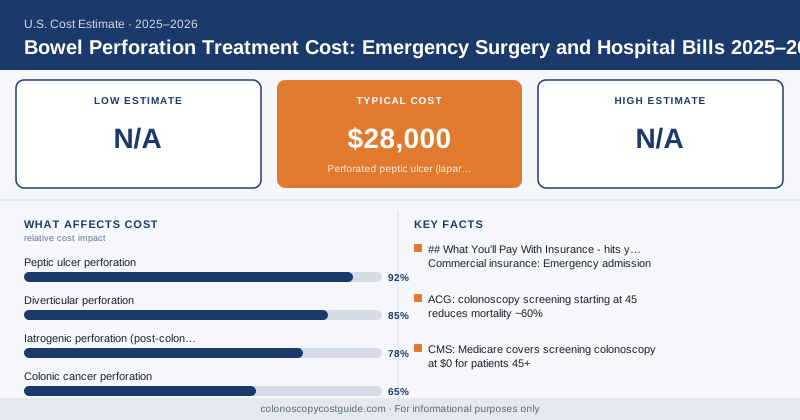
Bowel Perforation Treatment Cost: Emergency Surgery and Hospital Bills 2025–2026
{ if eq .Lang "zh" }{ else }{ end }A perforated ulcer in 1990 meant near-certain open surgery and a 10-day hospital stay. Today, some are managed laparoscopically in under two hours, with discharge in 3–5 days. Others still require the full 19th-century playbook — open laparotomy, abdominal washout, and a week in the ICU.
The cost follows that same wide range. Bowel perforation treatment runs anywhere from $15,000 for a small, conservatively managed iatrogenic perforation to $150,000 for a perforated colon cancer with fecal peritonitis. Here’s the breakdown by cause and approach.
What Causes Bowel Perforation?
The GI tract runs 25–30 feet. Any part of it can perforate — stomach, small bowel, or colon — and the cost of treatment depends heavily on which part and why.
Peptic ulcer perforation — Acid erodes through the stomach or duodenal wall. Historically the most common cause; still frequent in NSAID users and H. pylori-infected patients. Often managed with a laparoscopic patch (Graham patch procedure).
Diverticular perforation — A diverticulum (pouch) in the colon ruptures. More contamination than ulcer perforations due to colonic bacteria. May require bowel resection and temporary colostomy (Hartmann procedure). See diverticulitis treatment cost for more detail.
Iatrogenic perforation (post-colonoscopy) — A hole made during the colonoscopy procedure itself. Perforation rate is approximately 1 in 1,000–2,500 colonoscopies, per ASGE data. Small perforations caught immediately can sometimes be closed endoscopically; larger or delayed ones require surgery.
Colonic cancer perforation — A tumor erodes through or obstructs the colon to the point of rupture. Requires emergency resection. High-contamination, often requiring colostomy. Worst outcomes and highest costs.
Emergency Surgery Costs by Perforation Type
| Perforation Type | Typical Total Hospital Charges |
|---|---|
| Perforated peptic ulcer (laparoscopic repair) | $28,000 – $65,000 |
| Perforated peptic ulcer (open repair, delayed presentation) | $50,000 – $120,000 |
| Diverticular perforation — laparoscopic washout, no resection | $25,000 – $55,000 |
| Diverticular perforation — Hartmann procedure (colostomy) | $40,000 – $100,000 |
| Iatrogenic colonoscopy perforation — endoscopic clip closure | $5,000 – $15,000 (no additional OR) |
| Iatrogenic colonoscopy perforation — emergency laparoscopic repair | $25,000 – $60,000 |
| Iatrogenic colonoscopy perforation — open surgery (delayed) | $45,000 – $100,000 |
| Cancer perforation with emergency resection | $60,000 – $150,000+ |
The most cost-effective perforations to treat are those caught immediately — especially during colonoscopy, where an endoscopist can clip the defect shut before the patient leaves the suite. The most expensive are delayed presentations (>12 hours) of any type, because bacteria have had time to spread throughout the peritoneal cavity, setting up peritonitis and sepsis.
The 7–14 Day Hospitalization: Daily Costs
Regardless of surgery type, bowel perforation means hospitalization. The question is how many days.
| Hospitalization Component (Per Day/Episode) | Typical Billed Cost |
|---|---|
| Medical/surgical floor room (daily rate) | $2,000 – $4,500/day |
| ICU room rate (daily) | $3,500 – $8,000/day |
| IV broad-spectrum antibiotics (daily, inpatient) | $300 – $1,500/day |
| Nasogastric tube and TPN (bowel rest, 5–7 days) | $2,000 – $8,000 total |
| Abdominal drain management and radiologic checks | $1,500 – $5,000 total |
| Daily labs (CBC, metabolic panel, cultures) | $200 – $600/day |
| Daily physician/surgical team fees | $400 – $1,200/day |
| 7-day surgical floor stay total (rough estimate) | $20,000 – $50,000 |
| 14-day stay with ICU (rough estimate) | $60,000 – $130,000 |
The biggest driver of hospitalization cost after perforation surgery is ICU admission for sepsis management. Patients who arrive with frank peritonitis and hemodynamic instability spend days in the ICU on vasopressors, ventilator support, and continuous antibiotic titration. Those patients are at the upper end of every cost range above.
Conservative Management: When Surgery Can Wait (or Be Avoided)
Not every bowel perforation goes straight to the OR. Three specific scenarios can sometimes be managed non-surgically:
Small iatrogenic colonoscopy perforation — caught immediately, endoscopically clipped, patient stable: hospitalize, NPO, IV antibiotics, monitor. If no peritoneal signs develop over 24–48 hours, surgery can be avoided. Cost: $8,000–$20,000 for the observation admission.
Contained perforated peptic ulcer — CT shows the perforation is “contained” with a walled-off collection, not free air throughout the abdomen: IV antibiotics, NPO, NG tube, serial exams. Works in highly selected patients. Cost: $12,000–$30,000 for hospitalization without OR costs.
Sealed perforation — rare, but CT shows the perforation has spontaneously sealed with omentum: same conservative approach as above.
Conservative management fails — and escalates to emergency surgery — in 20–30% of selected cases. If you deteriorate on conservative management (fever spikes, worsening pain, sepsis signs), the surgical cost gets added to the hospitalization cost.
Colonoscopy-Specific Perforation: A Closer Look
Since this site focuses on colonoscopy and GI procedures, it’s worth detailing iatrogenic perforation specifically.
The ASGE reports colonoscopy perforation rates of:
- Diagnostic colonoscopy: approximately 0.03–0.1% (1 in 1,000–3,000)
- Therapeutic colonoscopy (polypectomy, EMR): approximately 0.1–0.3% (1 in 300–1,000)
- Endoscopic mucosal resection (EMR): up to 1–1.5% for large lesions
The timing of perforation recognition determines cost more than almost anything else:
- Recognized during colonoscopy: Endoscopist clips it immediately. Hospitalize for 24–48 hours of observation. Cost: $5,000–$15,000.
- Recognized within 6–12 hours (patient has increasing abdominal pain after discharge): Emergency laparoscopic repair. Cost: $25,000–$60,000.
- Recognized after 12–24 hours (peritonitis has developed): Emergency open surgery, potential Hartmann. Cost: $50,000–$120,000.
If you have significant abdominal pain, fever, or shoulder pain (referred diaphragmatic irritation from free air) after a colonoscopy, go to an ER immediately. Don’t wait until morning. The cost difference between a 6-hour and a 24-hour delay is tens of thousands of dollars — and vastly different outcomes.
Colostomy Reversal: The Follow-On Cost
When a Hartmann procedure is performed — resecting the perforated colon segment and creating a temporary colostomy — reversal surgery is typically planned 3–6 months later once the patient has recovered.
Colostomy reversal (Hartmann reversal) adds:
- Surgical facility fee: $15,000–$35,000
- Surgeon fee: $4,000–$10,000
- 2–4 day hospital stay: $8,000–$18,000
- Total reversal cost: $27,000–$63,000
Not all Hartmann procedures get reversed — older patients, high surgical risk individuals, or those with cancer may keep the permanent colostomy. But for candidates who do reverse, it’s a substantial additional cost to plan for, usually 6–12 months after the initial emergency.
What You’ll Pay With Insurance
Commercial insurance:
- Emergency admission hits your inpatient deductible immediately ($1,000–$4,000)
- Coinsurance until OOP maximum; a surgical perforation admission almost always hits the annual OOP max
- The 2026 ACA OOP maximum is $9,200 for individual plans
- Your worst-case out-of-pocket: your OOP maximum, possibly doubled if admission spans two calendar years
Medicare:
- Part A deductible $1,676 per benefit period covers first 60 days
- Surgeon, anesthesiologist: Part B at 80/20 after Part B deductible
- Medigap policies cap exposure significantly
No insurance:
- Full hospital charges — apply for charity care before or immediately after discharge
- Most nonprofit hospitals reduce or eliminate bills for patients at or below 200–300% of the federal poverty level
Bowel perforation is serious, but the medical and financial outcomes are largely determined by how quickly it’s identified and treated. Understanding the cost landscape helps you make faster decisions if symptoms develop — which is exactly when speed matters most.
{ if eq .Lang "zh" }