Blood in Stool Workup Cost: What Diagnosing It Actually Costs
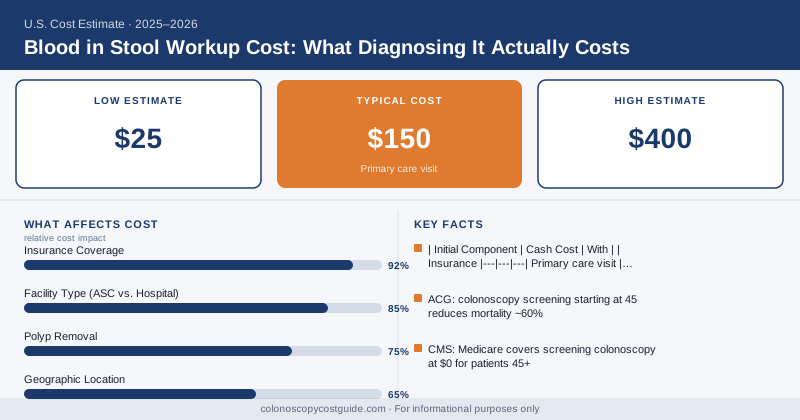
{ if eq .Lang "zh" }{ else }{ end }Blood in your stool can mean anything from a tiny hemorrhoid to something you really don’t want to ignore. The good news: most causes are benign. The cost of figuring out which one you’re dealing with ranges from about $150 to over $6,000, and where you land depends almost entirely on what the first exam turns up.
Here’s how the workup actually unfolds, dollar by dollar.
Start With the Color (and the Office Visit)
The first thing your doctor wants to know is what the blood looks like. Bright red usually points lower — hemorrhoids, fissures, or the rectum. Dark or tarry stool points higher up the GI tract. That distinction changes which tests get ordered, and therefore the cost.
Every workup starts with a history, a physical, and usually a stool test.
| Initial Component | Cash Cost | With Insurance |
|---|---|---|
| Primary care visit | $150 – $400 | $25 – $75 copay |
| Fecal immunochemical test (FIT) | $20 – $100 | $0 – $30 |
| Digital rectal exam | Included | Included |
| CBC blood test (check for anemia) | $50 – $150 | $5 – $40 |
| In-office anoscopy | $100 – $300 | $0 – $100 |
According to the CDC, about 1 in 20 Americans will develop colorectal cancer in their lifetime, which is exactly why doctors don’t wave off blood in the stool even when hemorrhoids are the obvious suspect.
When You Need a Scope
If the office exam doesn’t explain the bleeding, or you’re over 45, or you’ve got alarm features like weight loss, the next step is a scope. For lower-tract bleeding, that means a colonoscopy. For suspected upper-tract bleeding, your doctor may order an upper endoscopy instead.
| Procedure | Total Billed Cost |
|---|---|
| Diagnostic colonoscopy | $1,200 – $5,000 |
| Colonoscopy with biopsy or polyp removal | $2,000 – $6,500 |
| Upper endoscopy (EGD) | $1,000 – $4,000 |
| CT scan of the abdomen | $300 – $3,000 |
A scope done for a symptom is billed as diagnostic, not screening. That matters a lot for your wallet — there’s a reason a colonoscopy gets so expensive once it’s coded diagnostic, and the bill is subject to your deductible.
Key Takeaway
What If There’s No Insurance?
Paying out of pocket changes the math. A colonoscopy without insurance can run $2,000–$5,000 all-in, though cash-pay rates at ambulatory surgery centers are often far lower than hospital prices. If any tissue is removed, the biopsy adds its own cost — typically $200–$800 for the lab work alone.
The Bottom Line on Cost
Most people with a single episode of bright-red bleeding and an obvious hemorrhoid spend $150–$500 and stop there. Add a colonoscopy and you’re looking at $1,500–$6,000 depending on facility, sedation, and whether anything gets removed. The single biggest cost lever is the setting: hospital-based procedures cost far more than freestanding surgery centers for the identical scope.
If your doctor recommends a colonoscopy, ask three questions: Is this coded as diagnostic or screening? Where is it being done (hospital vs. surgery center)? And can I get a good-faith cost estimate in writing? Those three answers can swing your bill by thousands.
{ if eq .Lang "zh" }