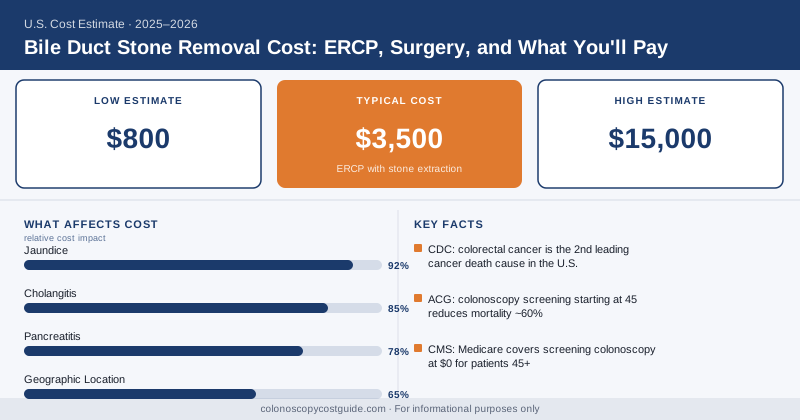
Bile Duct Stone Removal Cost: ERCP, Surgery, and What You'll Pay
{ if eq .Lang "zh" }{ else }{ end }Picture this: you went in for routine gallstone surgery, and the surgeon found a stone had slipped into your bile duct. Suddenly your $8,000 procedure is now a multi-step affair with a separate price tag. Bile duct stones, called choledocholithiasis, complicate the bill in ways most people don’t see coming.
The NIDDK notes that bile duct stones occur in roughly 10 to 15 percent of people who have gallstones, so this is far from rare. Here’s what removal actually costs.
The two main removal methods
There are two primary ways to clear a stone from the bile duct, and they sit at very different price points.
| Method | Cost (Uninsured) | With Insurance |
|---|---|---|
| ERCP with stone extraction | $3,000 – $15,000 | $800 – $3,500 |
| ERCP + sphincterotomy | $4,000 – $16,000 | $1,000 – $4,000 |
| Laparoscopic bile duct exploration | $12,000 – $22,000 | $2,500 – $6,500 |
| Open bile duct surgery | $15,000 – $25,000+ | $3,000 – $8,000 |
| Diagnostic MRCP imaging | $1,000 – $4,000 | $300 – $1,200 |
ERCP: the usual first choice
For most people, the stone comes out through an ERCP, an endoscopic procedure where a scope reaches the bile duct and a tiny basket or balloon pulls the stone free. It’s less invasive than surgery and usually cheaper, which is why it’s the standard approach.
Often the gastroenterologist will perform a sphincterotomy, a small cut to widen the duct opening, during the same session. That adds a bit to the cost but improves the odds of clearing the stone in one go.
Before the procedure, your doctor may order an MRCP scan or an endoscopic ultrasound to confirm the stone’s location. EUS is especially good at spotting small stones that other imaging misses, which can prevent an unnecessary ERCP.
Key Takeaway
When surgery is needed instead
Sometimes ERCP can’t reach or clear the stone, or the stone is too large. In those cases, surgeons explore the bile duct directly, either laparoscopically or through open surgery. This is more expensive, $12,000 to $25,000+, because it ties up an operating room and requires a longer hospital stay.
If you’re already scheduled for gallbladder removal, surgeons can sometimes clear a duct stone during the same operation, which is more efficient than two separate procedures.
Why a stuck stone gets expensive fast
A bile duct stone isn’t just a localized problem. If it blocks the duct, it can cause:
- Jaundice and liver irritation, picked up on liver function tests
- Cholangitis, a dangerous duct infection
- Pancreatitis, if the stone blocks the pancreatic duct too
Each complication adds hospital days and cost. A simple ERCP that turns into an emergency admission for cholangitis can triple the final bill.
How to control the cost
- Ask whether ERCP can resolve it before agreeing to surgery, it’s usually cheaper.
- Confirm in-network providers, the endoscopist, anesthesiologist, and facility may bill separately.
- Request a cash-pay estimate if uninsured, hospitals often discount substantially.
- Combine procedures when possible, clearing the stone and removing the gallbladder in one trip saves money.
The bottom line
Most bile duct stone removals happen via ERCP and cost $800 to $3,500 out of pocket with insurance, or $3,000 to $15,000 without. Surgery, when required, runs higher. The biggest cost driver isn’t the removal itself, it’s whether the stone caused a complication first. Catching and clearing it promptly keeps both the risk and the bill in check.
{ if eq .Lang "zh" }