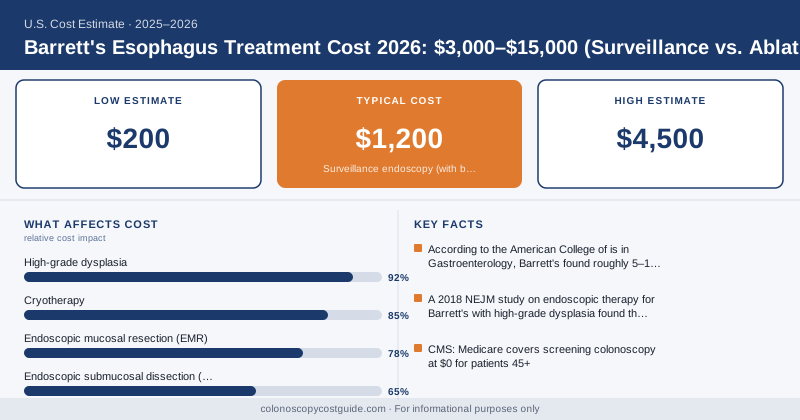
Barrett's Esophagus Treatment Cost 2026: $3,000–$15,000 (Surveillance vs. Ablation)
{ if eq .Lang "zh" }{ else }{ end }Most patients with Barrett’s esophagus don’t feel anything wrong. That’s the tricky part. You get a scope for persistent heartburn, and your gastroenterologist tells you the lining of your lower esophagus has changed. From that moment, you’re looking at years — potentially decades — of regular endoscopies, and possibly ablation treatment. Understanding what that costs is important.
According to the American College of Gastroenterology, Barrett’s is found in roughly 5–10% of patients who undergo endoscopy for GERD symptoms. The condition raises the risk of esophageal adenocarcinoma, which is why the monitoring protocol exists. Caught early, it’s treated endoscopically. Missed, it can become a cancer requiring esophagectomy.
Cost Summary: Surveillance vs. Treatment
| Intervention | Cost per Session (No Insurance) | Insured Out-of-Pocket |
|---|---|---|
| Surveillance endoscopy (with biopsies) | $800–$4,500 | $200–$1,200 |
| Radiofrequency ablation (RFA) | $3,000–$8,000 | $1,000–$4,000 |
| Cryotherapy (spray cryo or balloon cryo) | $3,500–$9,000 | $1,200–$4,500 |
| Endoscopic mucosal resection (EMR) | $2,500–$7,000 | $800–$3,500 |
| Endoscopic submucosal dissection (ESD) | $5,000–$15,000 | $1,500–$6,000 |
Costs per session only tell part of the story. The critical variable is how many sessions you’ll need — and that depends on whether you have dysplasia and how your tissue responds.
Surveillance Endoscopy: The Long-Term Cost
For non-dysplastic Barrett’s (no precancerous changes), the ACG recommends surveillance endoscopy every 3–5 years. That sounds infrequent, but over a 20-year monitoring period you’re looking at 4–6 endoscopies. At $800–$4,500 each, your lifetime surveillance cost runs $3,200–$27,000 without insurance — or roughly $800–$7,200 out-of-pocket with insurance after deductibles and coinsurance.
What Surveillance Includes That Drives Cost
For low-grade dysplasia, ACG guidelines call for endoscopy every 6–12 months initially, or ablation. That’s where costs climb significantly. Annual scopes at $800–$4,500 each add up to $1,600–$9,000 per year if you’re monitoring every 6 months.
High-grade dysplasia is the threshold where ablation is strongly recommended over continued surveillance alone.
Radiofrequency Ablation: What You’re Actually Paying For
RFA is the most common treatment for dysplastic Barrett’s. A balloon or focal catheter attached to the endoscope delivers controlled heat energy to ablate the abnormal tissue. New healthy squamous epithelium regrows over weeks.
The procedure itself takes 30–60 minutes and is done under conscious sedation or propofol. It’s typically outpatient, though some hospitals admit patients for monitoring.
Cost drivers for a single RFA session:
- Facility fee (ASC vs. hospital outpatient): $1,500–$5,000
- Gastroenterologist or thoracic endoscopist fee: $800–$2,000
- Anesthesia: $500–$1,200
- Ablation catheter/device fee (often passed to patient): $500–$1,500
Most patients need two to four RFA sessions spaced 8–12 weeks apart, followed by a confirmation scope. The full treatment course runs $10,000–$25,000 at self-pay rates.
| RFA Treatment Scenario | Total Cost (Self-Pay) | Total Cost (Insured) |
|---|---|---|
| 2-session RFA course | $8,000–$18,000 | $2,000–$7,000 |
| 3-session RFA course | $12,000–$27,000 | $3,000–$10,000 |
| 4-session RFA + confirmation scope | $15,000–$35,000 | $4,000–$14,000 |
Cryotherapy and EMR: When RFA Isn’t Enough
Cryotherapy (spray cryotherapy or cryoballoon) is an alternative when RFA isn’t effective or available. It’s used at specialized centers and costs roughly $3,500–$9,000 per session — similar to RFA but often done for refractory or nodular disease.
Endoscopic mucosal resection (EMR) removes visible nodules or raised lesions before or alongside RFA. If there’s a nodular area in your Barrett’s segment, EMR usually comes first: the lesion is lifted with saline injection and removed with a snare. EMR costs $2,500–$7,000 per session and is often done in the same procedure as RFA — but billed separately.
Endoscopic submucosal dissection (ESD) goes deeper than EMR and is used for larger or hard-to-remove lesions. It’s more technically demanding and expensive ($5,000–$15,000), and typically performed at academic or specialized GI centers with advanced endoscopy programs.
Insurance Coverage: What Plans Actually Pay
The good news: insurance covers almost everything for dysplastic Barrett’s.
- Surveillance endoscopy: Always covered as a diagnostic procedure. Not preventive, so ACA zero cost-sharing rules don’t apply. You’ll pay deductible plus coinsurance.
- RFA for low-grade dysplasia: Covered by most major commercial plans and Medicare when ACG-guideline criteria are met. Prior authorization commonly required.
- RFA for high-grade dysplasia: Broadly covered — this is the clearest medical necessity case.
- EMR: Covered as part of the endoscopy benefit when clinically indicated.
- ESD: Coverage can be inconsistent at some plans; may need peer-to-peer review.
The Cancer Risk Context
It helps to put treatment costs against the alternative. Esophageal adenocarcinoma — the cancer Barrett’s can progress to — is treated with esophagectomy (surgical removal of the esophagus), typically costing $50,000–$150,000 or more. Chemotherapy and radiation add to that.
A 2018 NEJM study on endoscopic therapy for Barrett’s with high-grade dysplasia found that endoscopic treatment produced durable remission in over 85% of patients at 5 years — at a fraction of the cost of surgery. The cost-effectiveness case for surveillance and timely ablation is strong.
Reducing Your Costs Over Time
Over a lifetime of Barrett’s management, your biggest cost controls are:
- Use an ambulatory surgery center: Saves $2,000–$5,000 per procedure vs. hospital outpatient.
- Spread procedures across deductible years strategically: If you have multiple sessions, clustering them to meet your annual deductible once is more efficient than splitting across two plan years.
- Use an HSA or FSA: All Barrett’s surveillance and treatment costs qualify as eligible medical expenses.
- Confirm the pathologist is in-network: Biopsy specimens may be sent to a lab outside your network — always ask where biopsies go before the procedure.