Barrett's Esophagus Surveillance Endoscopy Cost: What to Expect
Most patients learn they have Barrett’s esophagus during an endoscopy for chronic heartburn — then immediately ask what it means for their future. The answer involves years of regular surveillance scopes. Here’s what that actually costs.
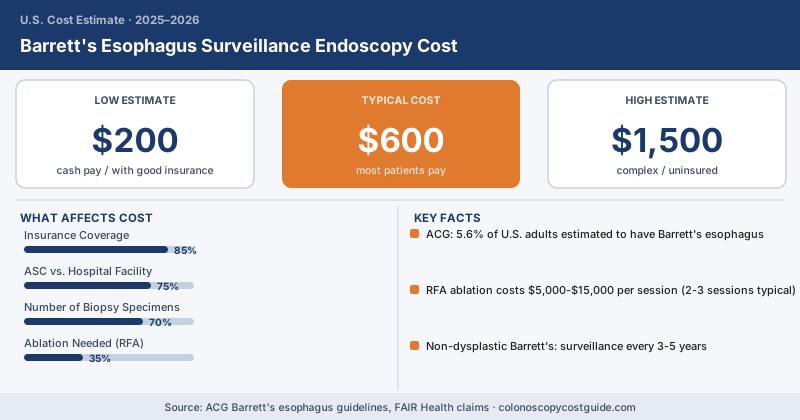
Barrett’s esophagus is a condition where the normal lining of the lower esophagus is replaced by tissue similar to the intestinal lining — a consequence of long-term acid reflux. According to the American College of Gastroenterology, approximately 5.6% of the US adult population has Barrett’s esophagus, and it’s the primary risk factor for esophageal adenocarcinoma. The cancer isn’t inevitable, but the surveillance protocol is designed to catch dysplastic changes before they become cancer.
The cost of that surveillance adds up over a lifetime.
The Per-Session Cost Breakdown
Each surveillance endoscopy is an upper GI endoscopy (EGD, CPT 43239) — same basic procedure as a standard upper scope, but with a standardized biopsy protocol called the Seattle protocol, which calls for 4-quadrant biopsies every 2 centimeters along the length of Barrett’s tissue. More biopsies mean more pathology specimens — and more pathology bills.
| Cost Component | Typical Range |
|---|---|
| Facility fee (ambulatory surgery center) | $500 – $1,800 |
| Facility fee (hospital outpatient) | $900 – $2,800 |
| GI physician fee | $250 – $600 |
| Anesthesia/sedation | $300 – $900 |
| Pathology (4–12 biopsy specimens) | $300 – $1,500 |
| Total (ASC) | $1,350 – $4,800 |
| Total (hospital outpatient) | $1,750 – $5,800 |
The pathology line is the most variable cost. Standard Barrett’s surveillance generates 8–16 biopsy specimens per session, each processed individually by the pathology lab. At $75–$150 per specimen with insurance adjustments, the pathology bill alone can run $600–$1,500. Without insurance, cash-pay pathology rates at independent labs can be substantially lower — sometimes $30–$60 per specimen.
The Frequency of Surveillance (And What That Adds Up To)
The ACG’s Barrett’s esophagus guidelines specify surveillance intervals based on dysplasia grade:
- Non-dysplastic Barrett’s (NDBE): endoscopy every 3–5 years
- Indefinite for dysplasia: repeat endoscopy in 6 months after PPI optimization
- Low-grade dysplasia (LGD): annually or ablation treatment
- High-grade dysplasia (HGD): intervention (ablation or surgery) within 3 months
Over a 20-year monitoring period for non-dysplastic Barrett’s, you’re looking at 4–7 surveillance endoscopies total. For a patient with confirmed low-grade dysplasia who opts for monitoring rather than ablation, the frequency climbs to annual — significantly raising lifetime costs.
Long-Term Cost Estimate for Non-Dysplastic Barrett's
When Treatment Is Needed: Ablation Costs
Patients with high-grade dysplasia or persistent low-grade dysplasia usually move from surveillance to treatment. Radiofrequency ablation (RFA) is the standard of care — it uses radio frequency energy delivered through an endoscope-mounted catheter to destroy the Barrett’s tissue.
The cost of RFA treatment:
- Per RFA session: $5,000–$15,000 in billed charges (CPT 43229)
- Number of sessions: Most patients need 2–3 sessions 3 months apart
- Total ablation course: $10,000–$40,000 in billed charges
- Post-ablation surveillance: Continues for life, initially every 3 months for the first year
Most commercial insurance covers RFA for high-grade dysplasia as a medically necessary procedure. Coverage for low-grade dysplasia is less consistent — about 70% of major commercial insurers cover it based on ACG guidelines, but some require prior authorization or peer-to-peer review. Medicare covers RFA for both HGD and LGD under specific criteria.
Insurance Navigation Tips
Barrett’s surveillance generates diagnostic procedure codes, not preventive codes. That means:
- Your deductible applies
- Coinsurance (usually 20%) applies after deductible
- Prior authorization may be required for ablation
If you’re getting a surveillance scope, do this before your appointment:
- Call your insurer and confirm CPT 43239 (EGD with biopsy) is covered under your plan
- Ask if your GI physician and facility are in-network — separately
- If ablation is recommended, request prior authorization before the procedure date
- Use an ASC rather than a hospital setting when your GI doctor has privileges at both — it can cut the facility fee by 40–60%
The Comparison: Surveillance vs. Treating Esophageal Cancer
The economics of Barrett’s surveillance become clearer when compared against the cost of treating esophageal cancer if it’s caught late. Esophagectomy — surgical removal of the esophagus for cancer — costs $60,000–$200,000+ in hospital charges. Chemotherapy and radiation for stage III or IV disease can exceed $100,000 per year. The $600–$1,200 every few years for surveillance is, from a pure cost perspective, an excellent investment.
That calculus is part of why most insurers cover Barrett’s surveillance with relatively minimal hassle — it’s one of the clearest examples of a monitoring protocol where early detection saves dramatically more than it costs.