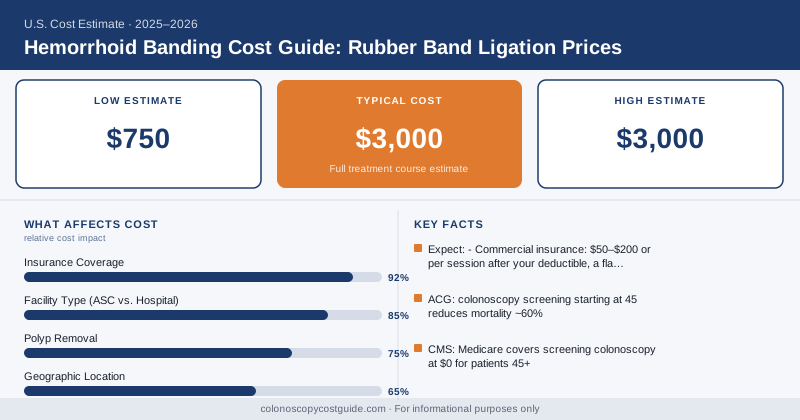
Hemorrhoid Banding Cost Guide: Rubber Band Ligation Prices
{ if eq .Lang "zh" }{ else }{ end }In 2010, treating internal hemorrhoids beyond home remedies usually meant surgery — a hemorrhoidectomy with a multi-week recovery. Today, it’s often a 10-minute in-office procedure with almost no downtime. Rubber band ligation changed the economics and the experience of hemorrhoid treatment, and it’s now the most common procedure GI and colorectal specialists perform for internal hemorrhoids.
Hemorrhoid Banding Cost Breakdown
| Setting | Cost Per Session | Sessions Typically Needed |
|---|---|---|
| In-office (GI or colorectal specialist) | $250 – $600 | 2–3 |
| Ambulatory surgery center | $500 – $900 | 2–3 |
| Hospital outpatient department | $700 – $1,200 | 2–3 |
| Full treatment course estimate | $750 – $3,000 total | — |
How Banding Works
During rubber band ligation, your doctor places a small elastic band around the base of an internal hemorrhoid using a special applicator inserted through an anoscope. The band cuts off blood flow, and the hemorrhoid shrinks and falls off within about a week. It only works on internal hemorrhoids — the American Society of Colon and Rectal Surgeons notes banding is not appropriate for external hemorrhoids, which have different nerve sensitivity and require different treatment approaches.
Most providers band only one or two hemorrhoids per visit, both to limit discomfort and to reduce the small risk of a complication called banding syndrome, which is more likely when multiple sites are treated at once.
Why Multiple Sessions Add Up
Since providers space treatments 4–6 weeks apart and address a limited number of hemorrhoids each time, your total cost reflects 2–3 visits, not one. That said, even a full course of banding — $750–$3,000 total — remains far less expensive than the $3,000–$8,000 typical cost of a surgical hemorrhoidectomy, which is why banding is the standard first-line approach for internal hemorrhoids that don’t respond to conservative treatment.
Banding vs. Surgery: When Each Makes Sense
Insurance Coverage
Rubber band ligation is covered by most commercial insurance plans and Medicare when performed for symptomatic internal hemorrhoids (not for cosmetic reasons). Expect:
- Commercial insurance: $50–$200 per session after your deductible, or a flat specialist copay if your plan uses copays instead of coinsurance
- Medicare Part B: Standard 80/20 cost-sharing applies after the annual deductible
- Medicaid: Covered in most states with minimal cost-sharing
Because you’ll likely need multiple sessions, ask your provider’s billing office whether they offer a bundled rate for the full treatment course — some in-office practices do, and it can meaningfully lower your total out-of-pocket cost.
What Recovery Looks Like
Unlike surgical hemorrhoidectomy, which often requires a week or more of significant discomfort, banding typically causes mild pressure or discomfort for 24–48 hours. Most patients return to normal activity the same day or the next, which is part of why it’s both cheaper and more tolerable than surgery for eligible patients.
The Bottom Line
A single hemorrhoid banding session costs $250–$1,200, and a full treatment course of 2–3 sessions runs $750–$3,000 — a fraction of surgical treatment cost for hemorrhoids that qualify. If you’re dealing with internal hemorrhoids that haven’t responded to over-the-counter treatments, ask your GI or colorectal specialist whether banding is right for your case before assuming surgery is your only option.
{ if eq .Lang "zh" }