Anoscopy Cost: What to Expect for This Simple In-Office Procedure
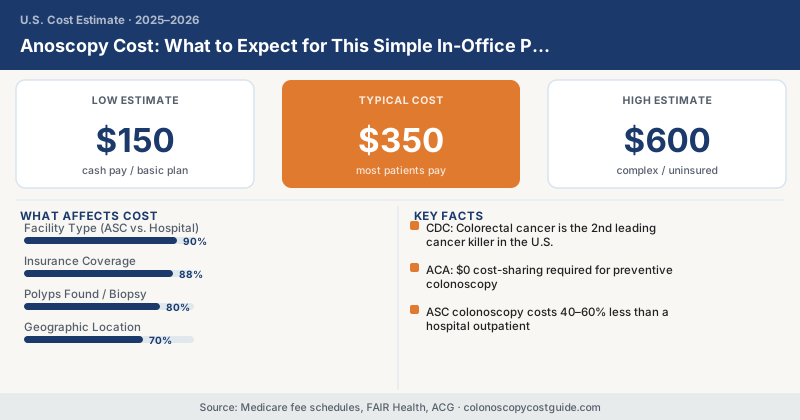
$150 to $600 for a procedure that takes less than five minutes. That’s what most patients pay for an anoscopy — and the wide range usually comes down to one thing: where you get it done.
Anoscopy is a quick, in-office exam of the anal canal and lower rectum using a short, rigid tube called an anoscope. It’s the go-to tool for diagnosing hemorrhoids, anal fissures, fistulas, polyps near the anal opening, and rectal bleeding when the source is close to the surface. It doesn’t require sedation, bowel prep, or an operating room. Most patients are in and out in under 30 minutes including the office visit.
How Much Does Anoscopy Cost?
The procedure itself is typically billed alongside an office visit, so you’re often paying for both. Here’s what that looks like by setting:
| Setting | Procedure Cost | Total Visit Estimate |
|---|---|---|
| Primary care physician office | $100 – $250 | $200 – $450 |
| General surgeon or colorectal surgeon | $150 – $400 | $300 – $650 |
| Gastroenterology office | $150 – $350 | $300 – $600 |
| Hospital outpatient clinic | $300 – $600 | $500 – $900 |
| Urgent care (limited availability) | $150 – $350 | $200 – $500 |
Academic medical centers and hospital-affiliated outpatient clinics add facility fees that can push the total well past $500. A private GI or colorectal practice is almost always cheaper for a procedure this simple.
What’s the CPT Code and What Does Medicare Pay?
Anoscopy is billed under CPT code 46600 (diagnostic anoscopy) or 46604 (anoscopy with dilation). If a biopsy is taken or treatment is performed (like cauterization of a polyp), additional codes apply.
Medicare’s national payment for CPT 46600 in a physician office setting is roughly $60–$90. In a hospital outpatient setting it’s higher — facility fees bring the total to $200–$400 under Medicare. You pay 20% of the Medicare-approved amount after your Part B deductible.
Does Insurance Cover Anoscopy?
Yes. Anoscopy is a diagnostic procedure and insurance covers it when there’s a documented medical reason — rectal bleeding, anal pain, suspected hemorrhoids, or follow-up after abnormal rectal exam. You’ll pay your normal specialist copay or coinsurance.
One important caveat: if your doctor bills the office visit and the anoscopy as separate line items (which is standard), you may see two charges on your EOB. That’s normal — not a billing error.
Anoscopy vs. Colonoscopy vs. Sigmoidoscopy — Which Do You Need?
These three procedures look at different parts of your GI tract:
- Anoscopy: Only the anal canal and lower inch of rectum — no sedation, no prep, done in minutes
- Flexible sigmoidoscopy: The rectum and lower colon (about 60 cm) — light prep, usually no sedation
- Colonoscopy: The entire colon — full bowel prep, sedation required, 2–4 hours total time commitment
If your symptoms point to hemorrhoids, fissures, or anal-area issues, anoscopy is appropriate and far cheaper. If there’s concern about polyps higher in the colon or a family history of colon cancer, you’ll need a colonoscopy.
Without Insurance: What You’ll Actually Pay
Uninsured patients face the widest variation. At an independent colorectal surgery practice, you might negotiate a cash price of $150–$300 for the anoscopy plus office visit. Hospital outpatient departments are less flexible, often $500 or more even for cash-pay patients.
FAIR Health data from 2024 shows that the 80th percentile charge for CPT 46600 in a physician office is approximately $220 nationally — meaning most providers bill under that amount. Urban markets (New York, LA, Chicago) skew higher; rural clinics and federally qualified health centers (FQHCs) are cheaper.
What to Expect During the Procedure
No bowel prep is required. You’ll be asked to empty your bladder and sometimes given a small enema beforehand if stool is present. The procedure involves lying on your side or in a knee-chest position. The anoscope is lubricated and gently inserted — it’s uncomfortable but brief. The whole exam takes 2–5 minutes.
If the doctor finds internal hemorrhoids, a biopsy may be taken or rubber band ligation may be performed at the same visit. That adds to the cost — rubber band ligation (CPT 46221) can add $400–$900 to the bill.
How to Keep Costs Down
- Ask for the procedure at a colorectal surgery or GI private practice rather than a hospital outpatient department — facility fees at hospitals inflate the bill significantly.
- Confirm both the office visit and procedure code are in-network before your appointment. Specialist networks vary by plan.
- Use your HSA or FSA — anoscopy is a qualified medical expense and you can use pre-tax dollars for the full cost.
- Community health centers and FQHCs offer sliding-scale fees for uninsured or low-income patients.
Anoscopy is one of the most affordable GI procedures you’ll encounter. If your symptoms suggest a simple anorectal problem, it’s a cost-effective first step that can save you the time and expense of a full colonoscopy — when that more extensive workup isn’t actually needed.