Anorectal Manometry Cost: What to Expect to Pay
What does a test that measures the pressure inside your rectum cost? More than most people expect — and less than it probably should. Anorectal manometry is a specialized GI diagnostic test ordered for chronic constipation, fecal incontinence, and pelvic floor disorders. It’s not a common household term, but if your GI doctor has ordered one, you’re right to want to know what you’re walking into financially.
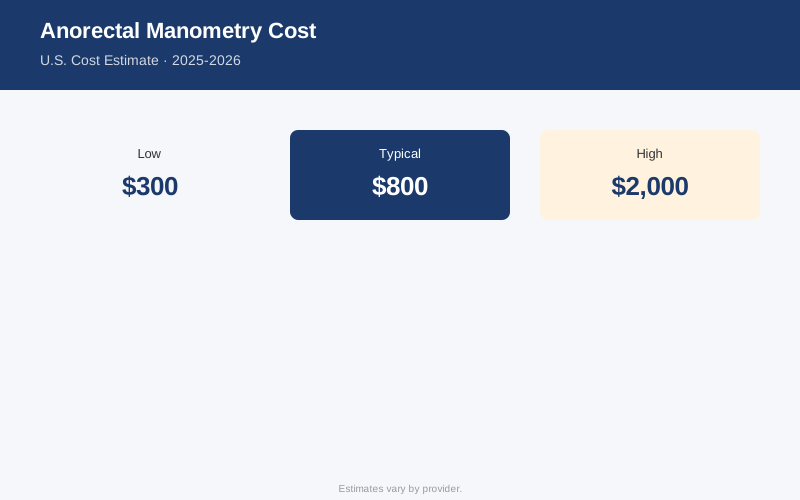
Cash prices typically run $300–$2,000 depending on facility type and location. With insurance, your actual cost depends entirely on your plan’s deductible status and the specific diagnosis codes used.
What Is Anorectal Manometry?
The test uses a thin, flexible catheter with a small balloon at the tip, inserted into the rectum to measure:
- Resting and squeeze pressures of the internal and external anal sphincters
- Rectal sensation thresholds
- The rectoanal inhibitory reflex (RAIR) — important for diagnosing Hirschsprung’s disease
- Coordination of pelvic floor muscles during simulated defecation
It takes about 30–45 minutes, requires no sedation, and is usually done in a GI motility lab or specialist’s office. The prep is minimal — sometimes a small enema beforehand.
Cost Breakdown
| Component | Typical Cash Cost | Notes |
|---|---|---|
| GI specialist consultation (pre-test) | $200 – $600 | Often required before test is ordered |
| Anorectal manometry (standard) | $300 – $1,200 | Facility and professional fees combined |
| High-resolution anorectal manometry (3D) | $600 – $2,000 | More detailed mapping; available at academic centers |
| Balloon expulsion test (add-on) | $50 – $200 | Tests pelvic floor coordination; often done at same visit |
| Biofeedback therapy (if indicated) | $150 – $400/session | Follow-on treatment for dyssynergia; 4–6 sessions typical |
| Defecography (X-ray or MRI-based) | $500 – $3,000 | Separate imaging test sometimes ordered concurrently |
When Is Anorectal Manometry Ordered?
GI specialists and colorectal surgeons order this test for specific indications. It’s not a routine test — you’d never get it as a screening tool. Common reasons include:
Chronic constipation — particularly when a pelvic floor disorder (dyssynergic defecation) is suspected rather than slow-transit constipation. The ACG estimates that dyssynergia accounts for 25–50% of cases of chronic constipation that don’t respond to standard laxative therapy.
Fecal incontinence — the test reveals whether sphincter weakness, poor rectal sensation, or inadequate squeeze pressure is the underlying cause, which guides treatment.
Pre-surgical evaluation — before hemorrhoid surgery, anal fistula repair, or sphincter procedures, surgeons often want a baseline pressure reading to avoid worsening incontinence.
Hirschsprung’s disease workup — in adults with longstanding constipation since childhood, the test checks for the absence of the RAIR.
Standard vs. High-Resolution Manometry: Is the Upgrade Worth It?
Standard anorectal manometry uses a simple catheter with a few pressure sensors and is adequate for most clinical questions. High-resolution manometry (HRM) uses a 3D pressure mapping catheter that produces detailed topographic images of sphincter function.
HRM is primarily available at large academic GI centers and motility labs. It costs 50–100% more than standard manometry but provides more granular data useful for research and complex cases. For most patients, standard manometry answers the clinical question adequately. Ask your GI doctor whether HRM is clinically necessary or if standard testing will suffice — the cheaper version is appropriate for the majority of cases.
Does Insurance Cover Anorectal Manometry?
Most major insurers — including Medicare, Medicaid, and commercial plans — cover anorectal manometry when ordered for medically documented indications. The CPT code used is most commonly 91122 (anorectal manometry).
With commercial insurance: If your deductible is met, expect 10–30% coinsurance on the professional and facility fees. Most patients with met deductibles pay $50–$200 out of pocket. If your deductible isn’t met, the full negotiated rate applies — typically $300–$900.
With Medicare: Part B covers anorectal manometry under the standard 80/20 rule after the annual deductible. Expect to pay about $60–$240 depending on the Medicare-approved amount.
Without insurance: Cash prices vary widely. Hospital outpatient departments charge $800–$2,000. A private GI motility office or ASC-affiliated practice typically runs $300–$700. Always call ahead and ask for the cash pay price — it’s almost always negotiable.
What About Biofeedback After Manometry?
If your manometry results show pelvic floor dyssynergia (the muscles are contracting when they should be relaxing — a common finding), your GI doctor will likely recommend biofeedback therapy. This is a series of sessions — usually 4–6 over several weeks — where a physical therapist or nurse practitioner uses real-time pressure feedback to retrain your pelvic floor muscles.
Biofeedback for GI conditions is covered by most commercial insurers when ordered for documented dyssynergia or fecal incontinence. Sessions typically cost $150–$400 each, with insurance reducing that to a copay of $30–$75 per session. The full treatment course of biofeedback typically runs $1,000–$2,500 at cash prices, or $200–$500 with good insurance coverage.
How to Keep Costs Down
- Ask for the test at an outpatient GI motility center, not a hospital. Hospital outpatient facility fees for manometry are often 2–3x the same test at a private GI or colorectal practice.
- Confirm pre-authorization if required. Some insurers require prior auth for high-resolution manometry but not standard. A denial because the wrong version was ordered without auth is avoidable with a quick call to your insurer beforehand.
- Bundle the balloon expulsion test. It’s often done the same day and costs very little incrementally — ask that it be included in the same visit to avoid a second copay/facility fee.
- Check for academic medical center clinical programs. Teaching hospitals often offer motility testing at reduced fees for patients who participate in clinical quality programs.
Anorectal manometry is a niche but genuinely useful test when ordered appropriately. The $300–$2,000 price range is significant, but so is the insight it provides — getting the right diagnosis often prevents thousands of dollars in ineffective empiric treatments.