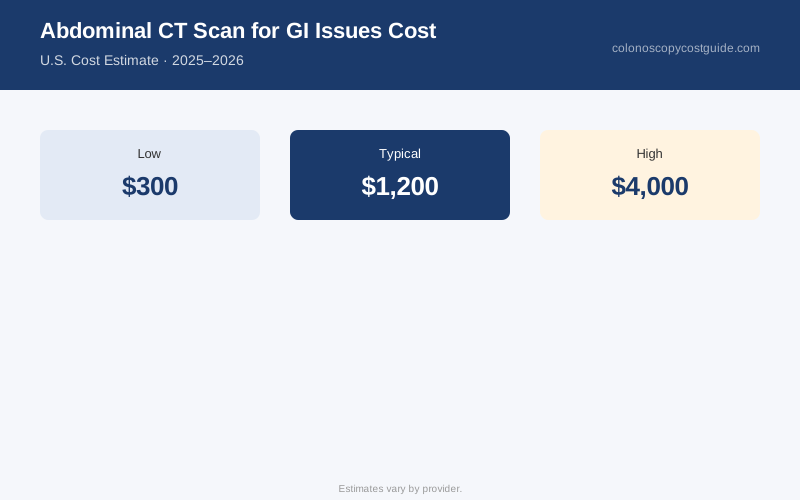
Abdominal CT Scan for GI Issues Cost: 2025–2026 Price Guide
42% of Americans report delaying or skipping a recommended medical test because of cost concerns, according to a 2023 KFF Health Tracking Poll. An abdominal CT scan is one of the tests most likely to trigger sticker shock — even though it’s one of the most important tools GI doctors use. Here’s the real cost breakdown.
What an Abdominal CT Scan for GI Issues Shows
When your gastroenterologist, internist, or ER physician orders a CT of the abdomen (and often pelvis), they’re looking at the entire GI tract from the outside in. Unlike a colonoscopy — which gives an interior view of the colon — a CT scan shows the bowel wall thickness, surrounding lymph nodes, adjacent organs (liver, pancreas, spleen), and any masses, fluid, or blockages.
Common GI indications include:
- Suspected diverticulitis or appendicitis
- Evaluating abdominal pain of unknown origin
- Suspected bowel obstruction
- Staging colorectal cancer or other GI cancers
- Follow-up for Crohn’s disease activity
- Pancreatitis workup
- Post-surgical monitoring
It’s fast (5–10 minutes in the scanner), widely available, and gives a lot of information — which is why it’s ordered frequently.
Cost by Scenario in 2025–2026
| Scenario | Typical Cost Range |
|---|---|
| Hospital ER (uninsured) | $1,500–$4,000 |
| Hospital outpatient radiology (uninsured) | $800–$2,500 |
| Freestanding imaging center (uninsured) | $300–$800 |
| Insured (deductible not met) | $400–$2,000 |
| Insured (deductible met) | $50–$300 coinsurance |
| Medicare Part B (after 20% coinsurance) | $100–$350 |
| CT with contrast vs. without | +$100–$300 for contrast |
The same scan at a hospital ER can cost 5–8x more than at a freestanding imaging center. This isn’t because the equipment is better — it’s the facility fee structure.
Contrast vs. Non-Contrast: Does It Affect Cost?
Yes, and it also affects what your doctor can see. An abdominal CT with IV contrast uses an iodine-based dye injected through an IV to make blood vessels, inflammation, and tumors more visible. A CT without contrast skips the dye.
For most GI indications (appendicitis, diverticulitis, colorectal cancer staging), contrast is preferred. Some situations — like kidney stones or quick bowel obstruction checks — may use non-contrast.
Contrast adds $100–$300 to the bill (radiologist’s contrast administration fee + pharmacy cost for the dye). If you’re allergic to iodine contrast dye, pre-medication protocols (steroids + antihistamines) are available but add another $50–$150.
A CT with oral contrast (you drink a liquid before the scan) doesn’t typically add significant cost but adds time — you arrive 60–90 minutes early.
Why Hospital Prices Are So Much Higher
Hospitals charge a facility fee on top of the radiologist’s professional fee. At a hospital, you’re paying:
- Technical fee (the hospital, for use of equipment, staff, and overhead): $600–$2,500
- Professional fee (the radiologist who reads the scan): $150–$400
At a freestanding imaging center, the technical component is $200–$600 — and they often bundle in the radiologist fee.
The American Hospital Association reports that hospital outpatient departments charge, on average, 2–3x what independent imaging centers charge for the same radiology CPT codes. For abdominal CT specifically, the spread is even larger.
CPT Codes to Know When Price Shopping
When calling imaging centers for quotes, use these CPT codes:
- 74177 — CT abdomen and pelvis with contrast (most common GI order)
- 74178 — CT abdomen and pelvis without contrast, then with contrast
- 74150 — CT abdomen only, without contrast
- 74160 — CT abdomen only, with contrast
Giving the specific code gets you an accurate quote rather than a generic estimate.
Insurance Coverage for Abdominal CT
Most commercial insurers cover abdominal CT when medically necessary with a physician’s order. Key things to know:
Prior authorization: Many plans (especially HMOs and some PPOs) require pre-authorization for non-emergency CT scans. Your ordering physician should handle this, but call your insurer to confirm it’s been submitted before your appointment. Missing this step is a leading cause of claim denials.
Preventive vs. diagnostic: A CT ordered to evaluate symptoms is diagnostic — it counts toward your deductible. There’s no free preventive CT equivalent to a preventive colonoscopy.
Imaging network: Some insurers have preferred imaging networks (e.g., United contracts with specific radiology groups). Going outside this network can trigger higher out-of-pocket costs even if the imaging center accepts your insurance.
ER scans: If you had a CT during an ER visit, it’s billed as part of the ER encounter. Your ER copay or coinsurance applies — but so does the facility fee, which can be substantial.
Medicare Coverage
Medicare Part B covers abdominal CT when medically necessary. The 2025 standard is:
- Part B deductible: $257 (if not yet met)
- After deductible: Medicare pays 80%, you pay 20%
- Your 20% coinsurance: typically $100–$350 depending on facility and scan type
If you had the scan in a hospital (inpatient admission), Part A rules apply instead. Medicare Advantage plans may have different cost-sharing — some offer $0 copays for diagnostic imaging at in-network centers.
How to Pay Less for an Abdominal CT
Choose a freestanding imaging center, not a hospital. If your CT is elective or scheduled (not an ER situation), ask your doctor if an independent imaging center is an option. You’ll pay 40–70% less for the same scan, read by the same type of board-certified radiologist.
Ask for the self-pay or cash rate. Many imaging centers have a cash price that’s lower than the insured price before deductible. A scan that bills at $1,200 to your insurance company may cost $350 cash.
Use GoodRx Care, MDsave, or Sesame. These platforms let you book imaging at negotiated cash rates. Abdominal CT prices of $250–$500 at local freestanding centers are common.
HSA/FSA eligible. CT scans are fully FSA and HSA eligible. Use these pre-tax funds to reduce your effective out-of-pocket cost.
The Bottom Line
An abdominal CT scan for GI issues costs $300–$800 at a freestanding imaging center and $1,500–$4,000 at a hospital ER — for the same scan. Insured patients typically owe $400–$2,000 before the deductible is met. The single best way to reduce your bill is to avoid hospital radiology departments for scheduled scans when a freestanding center is available.